How to successfully homeschool, even if you work 40 hours a week

As parents, we are constantly juggling time dedicated to work and time spent with our families. The pandemic changed the regular routine to include a unicycle and flaming knives.
2020 was the year our children's entire schooling forcefully stepped into our daily lives. This begs the question: can anyone balance their child's education while working full time?
The truth is that it's somewhere between challenging and impossible.
There is a reason you don't often hear about people balancing homeschooling and a career successfully. It is a monumental task that very few can accomplish (and hats off to those super-humans that do manage it!).
The time needed for quality homeschooling, even by itself, is a full-time job. Education is a profession and learning how to teach takes years of study, training and practice. However, there are educational opportunities out there that make educating your child whilst having a fulfilling career possible.

Having kiddos at home has its benefits.
So why do people want to educate their kids at home? Some of us love our kids being near, how effective it is, leaving so much more time to play, and spending less time commuting. We can concentrate on our passion projects and theirs. Having them close and a part of daily life significantly reduces stress in their lives and ours. But while some of us do homeschool full time, many of us have had a small taste with schools shutting down and the introduction of Emergency Remote Learning (ERL).
Nobody was ready for Emergency Remote Learning.
Many of us had to completely alter our own work-life and add another full-time job: educating our children. 2020 was the year we all learned that what we miss most in lockdown are playgrounds and everyday tiny interactions. We also discovered that the ERL being implemented in many countries is... painful.
ERL, as a reactionary measure, was hurriedly assembled to keep education available. And, though the work educators and institutions have done to adapt is nothing short of phenomenal, this plane is being built while flown.
Education as we know it has been curated, adapted, and changed over hundreds of years– for a specific structure. Transitioning to a vastly different delivery medium at the drop of a hat was a huge task.
Effective homeschooling and remote education have something in common: lots and lots of time, research, and curation. However, they are distinctly different.
Homeschooling vs. remote learning
There is an important distinction to make at this point between remote learning and homeschooling. They both occur in similar settings (your home); however, there is a significant difference. That difference is who is responsible for and who is delivering your child's education.
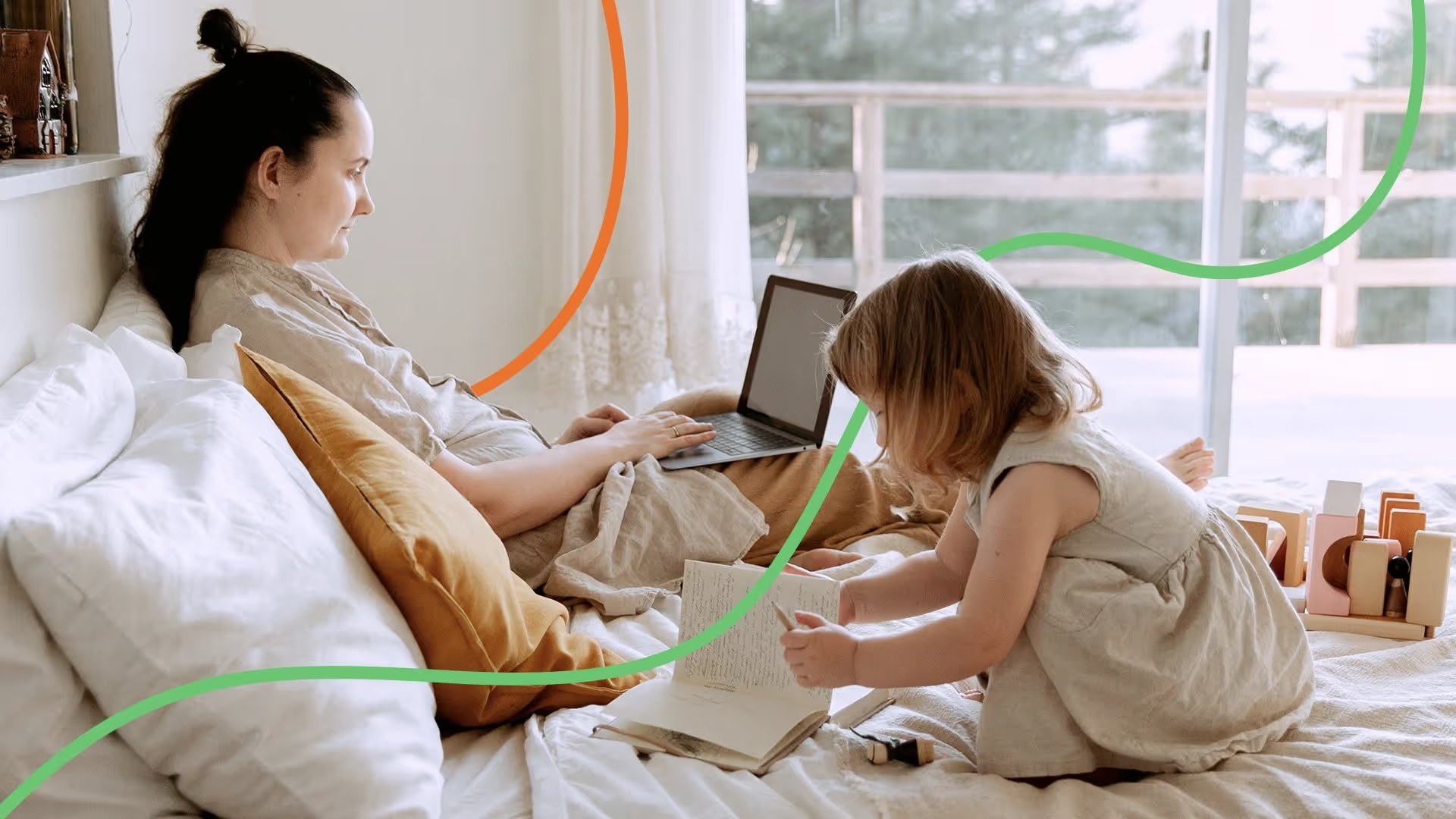
Benefits of homeschooling
Traditional homeschooling was on the rise even before COVID with a growth rate of between 2-8% every year. With the progression of digital learning tools, it is only a matter of time before learning from home takes larger steps into the mainstream. There are many compelling reasons, both ideological and practical for your children to learn at home:
- Your family's time and location are flexible
- Your child’s learning is tailored and personalised
- You do not miss this short, precious time called childhood, and they get the attention they need from you
- Better access to higher quality education
- Consistent educational setting for frequent movers and third culture families
- A change from a hostile school environment
- Schooling in a way that mirrors life today (working from home, etc.)
Downsides of homeschooling
It can't be all sunshine and rainbows, or else everyone would do it, right? With the parent left to organise their child's entire education, there doesn't leave time for a career, or much else.
- Your child does not come into intense physical daily contact with peers (although some say this is a benefit)
- It limits your child's opportunities to participate in team sports, competitions, and other extracurricular activities
- It causes financial restraints as traditionally one parent/guardian will likely have to choose between homeschooling and their career
- It consumes a lot of time, energy, and resources
- Your children require supervision 24/7
- You were not educated as a teacher and worry about your abilities
- Their horizons are only as broad as yours
The best of both worlds
As many of us have experienced this year, high-quality education at home is not as straightforward as switching on a laptop. But that does not mean it can’t be. A system designed to do just that requires structure, reliability, and resources just like traditional “brick and mortar” schools and it needs to be adaptable, flexible, and personalised, like homeschooling.
Enter... bina!
Creating a world where every child has access to quality education and parents don't have to choose between career and family.
The bina School weaves the best of homeschooling and traditional learning into a digital setting. Master educators, supported by data, deliver personalised learning. This means that you can still work from home full time, while we take careful care of the curation, personalisation, and delivery of your children's primary and middle education.
Some of bina's features include:
- Small classes of 7 students or less
- Comprehensive curriculum aligning with US and UK educational standards
- Consistent classes so no matter where your family is, your child can have the same classroom, teacher, and peers
- Experienced, highly-educated teachers
- Learning with kids from all over the world
- While your kids learn, you only need to be nearby, not active– meaning you can keep pursuing your career
We all want to spend more time with our family, and pursue careers and passions. What bina can do is address the downsides of homeschooling, while excelling at the positives.
Accredited, full-time school for grades K-12
Bring the best of the classroom to your home
See if we're a fit

More to read

Learning styles for kids: A practical guide for parents
Understand how your child likes to learn to keep them engaged with school. Help them become more adaptable by combining learning styles for kids.



The best 7 online accredited homeschool programs in Georgia
You're sold on the idea of having your kiddo learn at home for the flexibility, the personalization, and the fact that your child doesn't have to fit a…


Summer homeschool curriculum ideas without school-at-home
Summer often gives parents a clearer picture of how their child actually likes to learn. Some children suddenly read for fun again. Others become more…