Interdisciplinary Learning Helps Kids Remember More
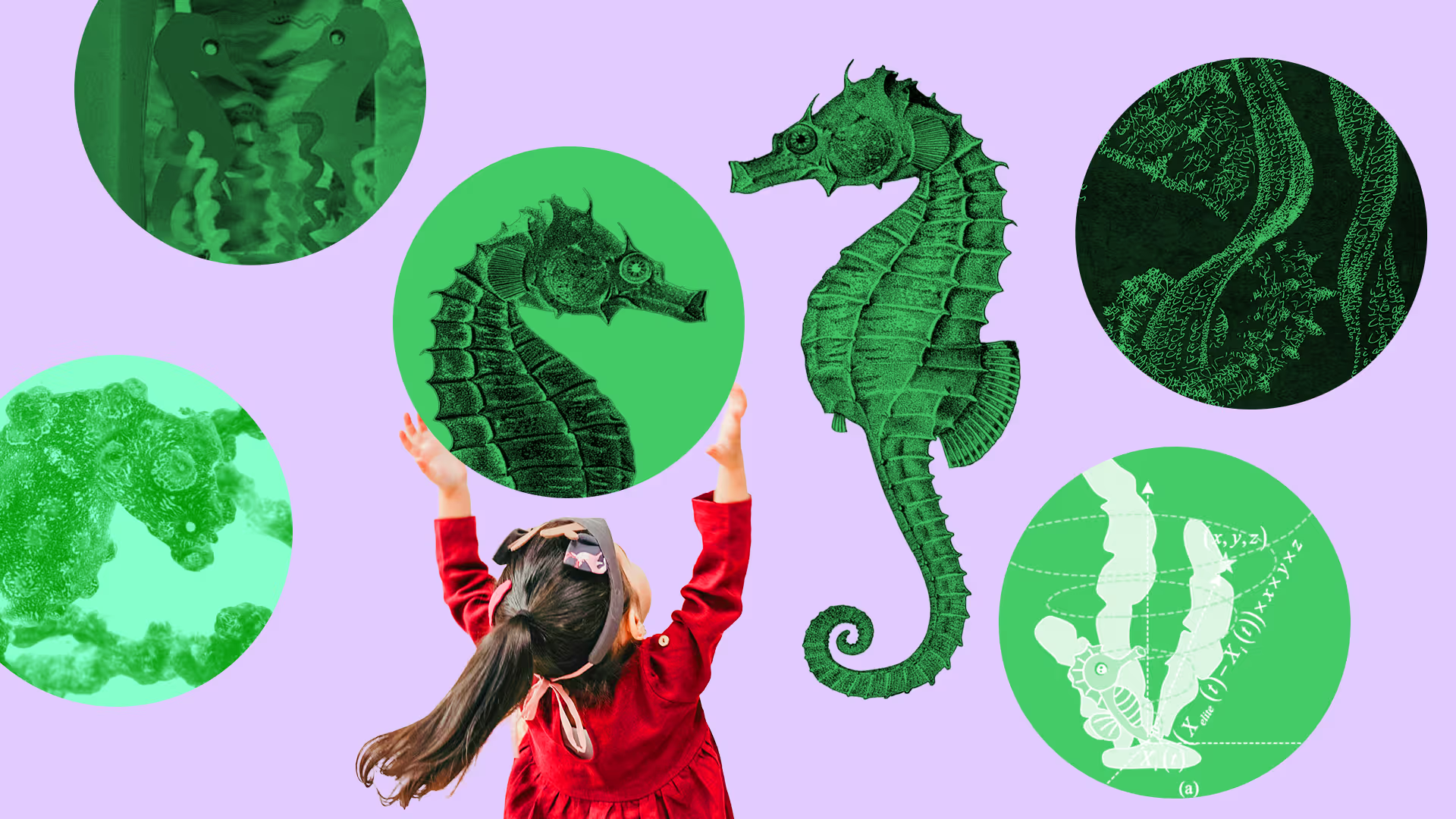
Picture this: your eight-year-old finishes their school day buzzing with excitement about seahorses. How they reproduce, where they live around the world, why their populations are changing, and the fascinating mathematical patterns in their movements through ocean currents. What started as a marine biology exploration naturally wove together geography, environmental science, and mathematics throughout their learning day.
Instead of your child struggling to remember isolated facts scattered across separate subjects, they're making connections that stick. The seahorse isn't just a science topic they'll forget by next week; it's become a doorway to understanding how the world works, sparking questions that span multiple disciplines and creating memories that will last a lifetime.
This is what happens when children experience true interdisciplinary learning, an educational approach that's transforming how they engage with knowledge and, more importantly, how much they remember. Let's dive into what interdisciplinary learning really is and how it can benefit your kiddo's education.
What Is Interdisciplinary Learning, Really?
As parents, we often hear educational buzzwords that sound familiar but make vastly different promises for our children's learning. Interdisciplinary learning is a unique educational approach where students integrate and develop information, concepts, methods, and skills from two or more disciplines at the same time. Rather than traditional education, where subjects exist in separate compartments, interdisciplinary learning deliberately weaves them together so they inform and enrich one another.
For example, when studying Ancient Egypt, children might analyze hieroglyphic patterns to understand linguistic and communication systems, or use Nile River flood data to explore how geography shaped agriculture, politics, and technology.
This connects closely to multidisciplinary learning, where subjects are taught separately around a shared theme. In that case, children might study Ancient Egypt in history, math, and art, but each subject remains in its own lane — the links between them are left for the learner to make on their own.
The Science Behind Why Interdisciplinary Learning Sticks
This learning approach is so effective because of the way children’s brains store and keep information. Memory research shows that when learning activities are connected and applied in different contexts, concepts are far more likely to “stick”, not just for next week’s quiz, but for months and even years.
This comes down to how working memory and long-term memory interact. Working memory is like the brain’s notepad - it holds small amounts of information for immediate use, helping with planning, comprehension, reasoning, and problem-solving. In children, this capacity is still developing, especially between ages 4 and 15, which means the way we present information matters enormously.
Here’s where interdisciplinary learning shines: it naturally breaks big ideas into smaller, meaningful chunks while showing how they connect. This organization builds a rich network of related concepts in the brain, making it easier to retrieve and apply knowledge later. For example, a learner exploring the water cycle might:
- Map global rainfall patterns in geography
- Observe evaporation in science experiments
- Read poetry about rain in literature
- Calculate rainfall data in math
Each activity strengthens the others, creating multiple memory pathways to the same concept. This is called interleaving, and describes the process of revisiting ideas in different ways over time. In interdisciplinary education, interleaving happens naturally as children encounter the same concept through many perspectives across their learning journey.
The Memory Advantages of Interdisciplinary Learning
Research in cognitive science consistently shows that active learning strategies, particularly those involving retrieval practice, produce far stronger long-term retention than passive strategies like rereading or listening. A landmark meta-analysis by Roediger and Butler (2011) found that the act of recalling information from memory not only strengthens that memory but also improves the ability to transfer knowledge to new contexts.
In interdisciplinary learning, this retrieval happens naturally. A child studying ocean biomes who calculates the percentage of Earth covered by water is simultaneously practicing mathematical recall and applying it to a geographical problem. This kind of cross-context application creates what cognitive psychologists call elaborative retrieval, where each act of recall is enriched by connections to other knowledge domains, making the memory more durable.
Other proven active learning methods, such as elaborative discussion (Chi, 2009), summarization, and generative learning activities like creating concept maps or diagrams, are built into well-designed interdisciplinary projects.
For example, while exploring an ecosystem, learners might:
- Create visual maps showing relationships between species
- Write a short story from the perspective of a migrating animal
- Debate environmental policies using evidence from both science and economics
- Design a conservation solution using STEM and social science insights
By embedding these strategies in real-world, multi-subject contexts, interdisciplinary learning ensures that retrieval practice isn’t an isolated drill but an engaging, meaningful part of the learning journey.
What This Looks Like in Practice: the bina school Approach
At bina, interdisciplinary learning is the foundation of how we teach. Our biome-based curriculum is designed to help children see the world as it truly is: interconnected, layered, and full of fascinating relationships between ideas.
Instead of teaching math at one time, science at another, and literature somewhere else, we invite children into immersive, multi-week learning journeys following themed “biomes”, where every subject naturally connects to the others.
Take our Arctic biome, for example. Over several weeks, learners might:
- Analyze real temperature data from Arctic research stations, building math skills while deepening their understanding of climate science.
- Explore the geometry of snowflakes, discovering mathematical patterns in nature.
- Map polar regions, understanding how geography shapes migration patterns, human settlement, and even political boundaries.
- Read traditional Inuit stories, learning narrative structure while gaining a cultural perspective on life in the Arctic.
And here’s the key: these aren’t separate “Arctic-themed” lessons. They’re intertwined. When a learner builds a mathematical model to predict ice melt, they’re also thinking about the environmental policies that could change that outcome. When they read Inuit oral histories, they’re also considering how geography and climate have shaped those traditions over centuries.
How do we make integration work
Because our classes are intentionally small, our educators can truly get to know each learner, their academic level, their interests, challenges, and sparks of curiosity. This lets us tailor content in real time. If a learner is fascinated by polar bears, we might use population data for math practice, habitat mapping for geography, and conservation debates for language and critical thinking.
Our learners come from around the globe, so there’s no single “default” perspective. A conversation about the Arctic might include a classmate who has lived near polar regions and another who sees the effects of climate change in their coastal community. That natural diversity of experience brings an authenticity you can’t script. We also don’t rely on one big end-of-unit test to measure learning. Because everything we do is digital, we can continuously track a learner’s progress across the web of skills they’re developing. Learners see this too, which builds self-awareness about their own learning process.
Projects are at the heart of every biome, and the way learners share their work is as varied as the learners themselves. Sometimes that means a carefully researched, written report; other times, a live presentation, a piece of visual art, a model, or even a short film. The format depends on the project’s goals and the skills being developed, but it always asks learners to apply their knowledge in a meaningful way. This variety matters. By presenting their understanding through different mediums, learners practice communication, creativity, and problem-solving, all while reinforcing the core concepts of the biome. It’s one more way we make sure what they’ve learned isn’t just remembered, but can be expressed, applied, and built upon.
When children feel seen, challenged, and supported, they don’t just learn more — they love learning more. And that’s what bina is all about.
Making the Choice That Supports Your Child's Growth
Every child is unique, and the best educational approach for your family depends on your child's individual needs, learning style, and circumstances. As a parent, you're looking for an approach that helps children remember more of what they learn, creates genuine enthusiasm for learning, develops critical thinking and problem-solving skills, and prepares children for an interconnected world.
The children who will thrive in tomorrow's world will be those who learned to see connections, think creatively across disciplines, and approach complex problems with confidence and curiosity rather than those who memorized the most isolated facts.
As you consider educational options for your child, remember that choosing interdisciplinary learning goes beyond academic achievement, though the research strongly suggests children learn more and remember more through this approach. It's about honoring your child's natural curiosity, supporting their developing brain's incredible capacity for making connections, and preparing them for a future where the ability to integrate knowledge from multiple domains will be one of their greatest assets.
The research shows clearly that interdisciplinary learning helps children remember more and love learning more. The question for you as a parent is whether you're ready to give your child an educational experience that matches their natural capacity for wonder, connection, and growth.
Your child's mind is already interdisciplinary. Perhaps it's time their education caught up.
Addressing Common Parent Concerns
"But Will My Child Master the Fundamentals?"
This concern weighs heavily on many parents' minds, and understandably so. The beautiful truth about quality interdisciplinary education is that it strengthens rather than sacrifices these fundamentals.
Interdisciplinary learning cannot exist separately from disciplines but is fundamentally founded on strong disciplinary knowledge, understanding and skills. When your child learns mathematical concepts through real-world problem-solving, they develop number sense, logical reasoning, and the ability to apply mathematical thinking to novel situations.
"Will This Prepare Them for Traditional Assessments?"
Research suggests that children who experience interdisciplinary learning often perform better on traditional assessments. When children truly understand concepts through interdisciplinary exploration, they can more easily adapt that knowledge to any testing format. They haven't just memorized procedures; they've developed deep understanding that transfers across contexts.
bina also provides support for families who need their children prepared for specific traditional assessments, ensuring no future educational doors are closed.
Finding the Right Educational Environment for Your Child
As you consider educational options for your child, the question becomes whether your child's current educational experience is optimizing their natural capacity for learning, memory, and growth.
If your child finishes their school day excited about what they've learned, making connections between different ideas, and asking questions that span multiple subjects, they may already be experiencing effective interdisciplinary learning. If they struggle to remember what they learned last week, seem disengaged with school, or view subjects as completely separate entities, it might be time to explore alternatives.
Online schools like bina are pioneering new approaches to interdisciplinary learning. Without the constraints of traditional classroom structures, they can create more flexible, integrated curricula that leverage technology to provide rich, multi-sensory learning experiences.
Accredited, full-time school for grades K-12
Bring the best of the classroom to your home
See if we're a fit

More to read
Project-based learning in elementary school: Why it works
Discover how project-based learning helps elementary kids thrive with real-world projects, hands-on lessons, and deeper engagement.

Tiny classes, huge impact: 10 benefits of smaller class sizes
Learn about the real benefits of smaller class sizes. See how a more personal approach helps every child feel seen, supported, and inspired to learn.
Nature-based homeschool curriculum: Choices, resources, and challenges
Discover the types of nature-based learning, which nature based homeschool curriculum options exist, and how bina helps kids understand the world.